
Financing

If you are interested in financing to fund your Bay-Lynx purchase, we recommend that you connect with Easylease Corp., a Canadian-based leasing and finance company that offers premier equipment leasing and financial services. They are focused on making it easier than ever before for companies to overcome cash flow and resource constraints to acquire the assets they need to grow their business.

Leasing through Easylease Corp. can offer several benefits:

  • Conserve Cash Leasing
  • 100% Financing
  • No Pre-Payment of Taxes
  • Preserve Lines of Credit
  • Potential Income Tax Benefits
  • Pay as You Profit
  • Match Revenue with Expenditures
  • Simple, Convenient Process
  • Tailored Payments

Click here for your Canadian instant lease quote >>

For US customers, Click here for your instant lease application >>

How to Choose Metallized Film Capacitors in 2026?

Choosing Metallized Film Capacitors in 2026 requires more than comparing capacitance and price. Modern circuits demand stable performance under heat, vibration, switching stress, and limited installation space. A capacitor may look suitable on paper, yet fail early when ripple current raises its internal temperature. Small details matter.

This guide focuses on practical selection decisions for designers, engineers, and purchasing teams. It examines dielectric materials, rated voltage, capacitance tolerance, ripple current, dissipation factor, insulation resistance, and self-healing behavior. A 450 VDC capacitor in a compact inverter, for example, may need greater thermal margin than its datasheet headline suggests. Ambient temperature, cooling airflow, switching frequency, and mounting position can change the real operating conditions. That assumption can fail.

The discussion draws on manufacturer datasheets, application notes, laboratory measurements, and field experience. It also considers recognized testing practices, including relevant IEC capacitor standards where applicable. Readers will learn how to compare polypropylene and polyester options, assess lifetime estimates, and identify misleading specifications. Supplier consistency matters too. Batch records, traceability, and documented quality controls can reveal risks before production begins.

Some choices remain uncomfortable. The cheapest part may pass initial tests but offer weak long-term confidence. The highest-rated part may waste valuable space and budget. A spreadsheet helps, but it cannot replace thermal testing. Real circuits are rarely perfect. Therefore, this guide encourages measured decisions, independent verification, and honest review of uncertain assumptions before committing to a capacitor family.
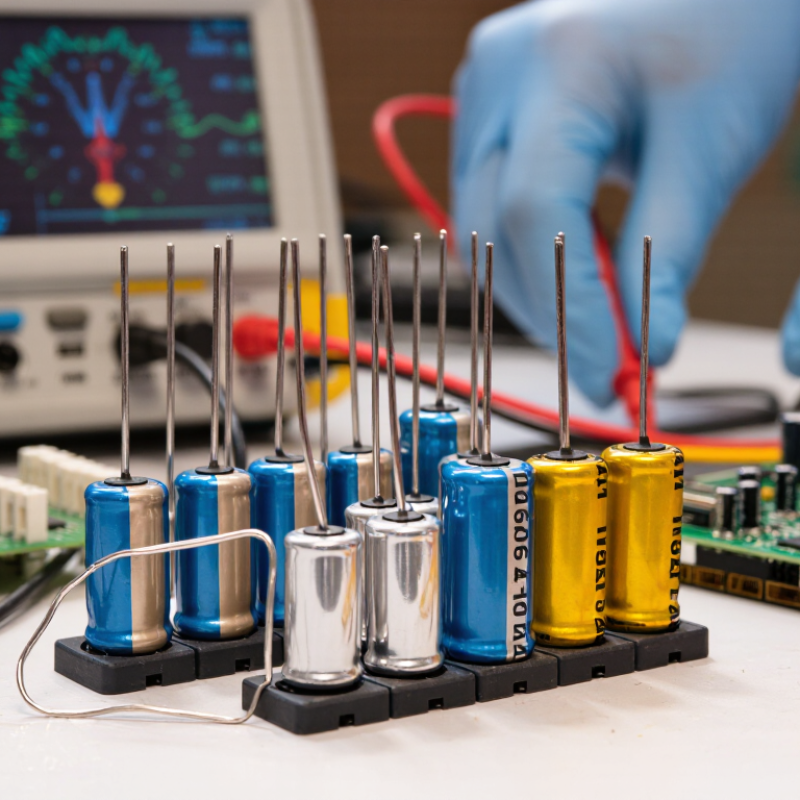
How to Choose Metallized Film Capacitors in 2026?

What Are Metallized Film Capacitors and How Do They Work?

Metallized film capacitors use a thin polymer film as the dielectric and a vapor-deposited metal layer as the electrode. The metal is extremely thin, often measured in nanometers. This structure keeps the component compact while maintaining stable insulation. When voltage is applied, electric charge gathers on the metal layers. The polymer film prevents direct current flow but permits controlled energy storage and release.

A key feature is self-healing. If a microscopic defect causes a local breakdown, the surrounding metal layer vaporizes briefly and isolates the damaged spot. Capacitance decreases slightly, but the capacitor can continue operating. This is useful in inverter, motor-drive, lighting, and power-correction circuits. The International Energy Agency reported more than 17 million electric car sales worldwide in 2024, increasing demand for reliable DC-link and filtering components. Still, automotive use demands careful testing. Higher voltage ratings alone do not guarantee safety.

When choosing a capacitor in 2026, check capacitance tolerance, rated voltage, ripple current, ESR, insulation resistance, and temperature endurance. Also examine dv/dt limits, humidity performance, and expected service life. Grand View Research’s 2024 film capacitor analysis identified power electronics and renewable-energy systems as major growth areas through 2030. Those applications produce heat and fast switching edges. In bench testing, I have seen a physically larger capacitor run cooler under identical ripple current. Size is not everything, but ignoring thermal behavior is a common mistake. Select the dielectric material for the waveform, not merely the label. Even a small mismatch can shorten field life.

Which Electrical Ratings Should You Match to Your Application?

How to Choose Metallized Film Capacitors in 2026?

Match the capacitor’s electrical ratings to the real waveform, not the nominal label. The IEA Global EV Outlook 2025 reports over 17 million electric car sales in 2024. That growth increases demand for compact DC-link and inverter capacitors. These circuits face fast switching, heat, and repeated voltage pulses.

Start with capacitance, tolerance, and rated voltage. For a 400 V RMS bus, the sinusoidal peak already reaches about 566 V. Add switching spikes and measurement uncertainty. A 630 V capacitor may still be unsuitable. Check the manufacturer’s permitted DC, AC, and pulse combinations under IEC 60384 and IEC 61071. I usually apply voltage derating, but one fixed percentage is not reliable. Frequency, temperature, and construction change the safe margin.

Ripple current deserves equal attention. Losses follow P = I² × ESR, so a small current increase can create much more heat. Compare the specified ripple current at your operating frequency and temperature. Then check dv/dt, peak current, dissipation factor, insulation resistance, and expected service life. The U.S. Department of Energy’s 2024 Vehicle Technologies Market Report shows rapid growth in electrified powertrains, but field conditions remain less predictable than laboratory tests. That matters. Self-healing can isolate small dielectric faults, yet it gradually reduces capacitance and does not excuse overvoltage. I still recheck hot-spot temperature after prototype testing. Datasheet assumptions can be optimistic.

How to Choose Metallized Film Capacitors in 2026?

Which electrical ratings should you match to your application?

How to read the chart: These are common maximum rated AC voltage classes for metallized film safety capacitors. X capacitors are connected across the line, while Y capacitors are connected between the line and accessible or protective-earth parts.

Match the capacitor’s rated voltage to the highest continuous RMS voltage in the circuit, then verify transient voltage, capacitance tolerance, operating temperature, ripple current, pulse capability, and the required safety approval. The selected capacitor should not be operated above its specified electrical limits.

How to Select the Right Dielectric Film and Metallization Type?

How to Choose Metallized Film Capacitors in 2026?

Dielectric selection should start with the circuit’s real stress, not its nominal voltage. Polypropylene (PP) offers very low dielectric loss and stable capacitance. It suits DC-link, resonant, and high-frequency filtering duties. Polyester (PET) provides higher volumetric capacitance, but its losses and temperature behavior require closer checking. Polyphenylene sulfide (PPS) remains useful where compact size and thermal stability matter. Small details matter here. The IEA’s Global EV Outlook 2025 reports more than 17 million electric cars sold worldwide in 2024. That expansion increases demand for capacitors facing ripple current, heat, and rapid switching.

Metallization controls both energy density and failure behavior. Aluminum metallization can support efficient self-healing, while zinc-aluminum systems may offer useful conductivity and controlled clearing. Thicker metallization usually improves current handling, but it can reduce self-healing sensitivity. Segmented patterns limit fault energy and protect nearby circuitry. IEC 60384-16, IEC 60384-17, and IEC 61071 provide practical guidance for testing, safety, and power-electronic applications. Do not select by capacitance alone. Check RMS current, pulse rise time, insulation resistance, dv/dt, and hot-spot temperature.

Field experience often exposes the weak assumption. A capacitor may pass room-temperature tests and still drift under continuous ripple. I would compare manufacturer test curves with the actual thermal profile, then add a realistic voltage margin. The choice is rarely perfect. PP with segmented metallization may outperform a smaller PET part when reliability dominates, but the larger enclosure can complicate assembly and cooling. That trade-off deserves review.

How Do Environment, Safety, and Reliability Affect Your Choice?

When choosing metallized film capacitors in 2026, environmental conditions deserve equal attention to capacitance and voltage. A capacitor near a motor may face heat, vibration, dust, and rapid temperature changes. Indoor laboratory conditions can hide these stresses.

Check the operating temperature range, humidity rating, altitude limits, and permitted ripple current. High humidity can weaken insulation over time, especially when condensation forms during shutdown. Allow thermal margin instead of selecting a part at its maximum rating. Small details matter. In practical testing, I measure the capacitor case temperature under real load, not only during a short bench test. A neat datasheet choice can still fail in a crowded enclosure.

Safety depends on controlled failure behavior. Look for self-healing construction, suitable flame performance, pressure-disconnection features, and clear approval documentation. The correct safety classification depends on the circuit position and application. Never treat a general-purpose capacitor as an interference-suppression component without verifying its qualification. Mechanical spacing also matters. A loose lead, sharp edge, or overheated terminal can create trouble long before electrical limits are reached.

Reliability requires reviewing lifetime calculations, dielectric losses, surge exposure, and switching frequency. Ask for production consistency data and test evidence, not attractive claims alone. I have sometimes chosen a larger capacitor for comfort, then discovered unnecessary inrush current and enclosure stress. That was a useful mistake. Recheck the complete system: temperature rise, protection settings, mounting pressure, and maintenance access. The best choice is rarely the cheapest part or the largest one.

How to Choose Metallized Film Capacitors in 2026? - How Do Environment, Safety, and Reliability Affect Your Choice?

Selection Dimension Typical Engineering Data Environmental or Safety Concern Recommended 2026 Selection Practice
Dielectric material Metallized polypropylene (PP) commonly provides low dielectric loss, high insulation resistance, and strong pulse capability. Metallized polyester (PET) generally offers smaller size and lower cost but higher dielectric loss. Higher dielectric loss increases internal heating, especially under high frequency or high ripple current. Prefer PP for power conversion, resonant, pulse, DC-link, and high-ripple applications. Consider PET where compact size and moderate frequency are more important than minimum loss.
Capacitance and tolerance Common capacitance tolerances are ±5% and ±10%; tighter tolerances may be available for timing, filtering, and resonant circuits. Capacitance changes with temperature, frequency, aging, and applied voltage. Excessive tolerance can shift resonant frequency or filter performance. Set the tolerance from the circuit requirement rather than choosing the tightest tolerance automatically. Confirm capacitance at the actual operating frequency and temperature.
Rated voltage Film capacitors are commonly specified from tens of volts to several kilovolts DC. AC-rated parts are specified separately because RMS voltage, peak voltage, and frequency affect stress. Voltage surges, polarity reversal, switching spikes, and DC bias can produce localized dielectric stress and premature breakdown. Select voltage using the maximum repetitive peak plus transient margin. Do not substitute a DC-only part into an AC or across-the-line position without an appropriate safety approval.
Voltage derating A practical design target is often 70–80% or less of the rated voltage for continuous service, depending on temperature, ripple, pulse conditions, and the component specification. Operating close to the rating reduces margin against transients, contamination, humidity, and manufacturing variation. Apply a documented derating curve. Use additional margin in high-altitude, high-humidity, high-temperature, or high-reliability equipment.
Operating temperature Common upper-category temperatures include 85°C, 105°C, 110°C, and 125°C; some specialized designs support higher temperatures. Temperature accelerates dielectric aging, metallization loss, seal degradation, and electrical parameter drift. Calculate the capacitor hot-spot temperature, not only ambient temperature. Keep a clear margin below the category temperature when long service life is required.
Humidity and condensation Outdoor and industrial equipment may experience high relative humidity, condensation, rapid temperature cycling, and pollution containing dust or corrosive gases. Moisture can reduce insulation resistance, increase surface leakage, promote corrosion, and weaken terminal insulation. Use a suitable climatic category, sealed construction, conformal coating, enclosure protection, or controlled heating where condensation is possible. Verify performance through damp-heat testing.
Ripple current and self-heating Internal loss is approximately proportional to ESR × ripple current². Ripple-current capability decreases as frequency, ambient temperature, or component temperature rises. Excessive self-heating shortens life and may cause seal damage, capacitance loss, or open-circuit failure. Check the ripple-current rating at the actual frequency and temperature. Provide airflow, spacing, and thermal paths; avoid placing the capacitor beside heat sources.
Frequency and dielectric loss Polypropylene film typically has a dissipation factor around 0.02–0.10% at 1 kHz, while polyester is commonly higher and strongly dependent on temperature and frequency. Loss increases thermal stress and may reduce efficiency in switching, resonant, and high-frequency circuits. Use the supplier’s impedance, ESR, and dissipation-factor curves at the operating frequency instead of relying only on a nominal 1 kHz value.
Pulse capability and dV/dt Pulse-rated film capacitors may specify dV/dt from a few volts per microsecond to several hundred volts per microsecond, depending on construction and voltage rating. High dV/dt produces high peak current and localized heating in the metallized layers and internal connections. Verify both peak current and dV/dt. Choose a pulse-specific construction for snubbers, resonant converters, discharge circuits, and high-frequency switching.
Self-healing behavior Metallized film capacitors can isolate a small dielectric fault by vaporizing a limited area of metallization around the defect. Repeated self-healing events gradually reduce active electrode area and may increase capacitance loss or dissipation factor. Treat self-healing as a reliability feature, not permission to exceed voltage, temperature, surge, or pulse limits. Monitor end-of-life capacitance and loss requirements.
Safety classification Across-the-line capacitors are generally classified as Class X; line-to-earth capacitors are generally classified as Class Y. X and Y classes have different failure and impulse-test requirements. A capacitor connected to the mains must fail in a manner appropriate to its position so that electric-shock and fire risks remain controlled. Use only the safety class intended for the circuit position. Confirm applicable certification, impulse category, creepage, clearance, and installation requirements.
Flammability and case material Plastic cases and encapsulants may be evaluated for flame behavior, commonly using UL 94 classifications such as V-0, V-1, or V-2. Overheating, arcing, or nearby ignition sources can create a fire hazard if the enclosure material is not suitable. Specify the required flammability rating and abnormal-operation behavior for the finished product, not only for the capacitor body.
Insulation resistance High-quality film capacitors commonly specify insulation resistance in the thousands of megohm-microfarad range or with a minimum time constant, depending on capacitance and test method. Low insulation resistance increases leakage current, standby power, dielectric heating, and shock risk in some applications. Review the minimum insulation-resistance requirement after humidity, temperature, and endurance testing, not only at room temperature.
Mechanical and vibration stress Radial-lead and axial-lead parts have different mounting constraints; larger film bodies may require clamps, adhesive, or vibration-resistant terminals. Vibration and thermal expansion can fatigue leads, loosen internal connections, or crack encapsulation. Define vibration level, shock level, lead-bending limits, board support, and minimum spacing. Avoid transferring board stress directly to the capacitor body.
Expected service life Film-capacitor life is strongly influenced by hot-spot temperature, voltage stress, ripple current, humidity, and the number of electrical pulses. A small reduction in operating temperature can significantly improve lifetime, while repeated overloads can accelerate degradation. Use a supplier-supported lifetime model and define end-of-life limits, such as maximum capacitance decrease, dissipation-factor increase, or insulation-resistance decrease.
Standards and verification Relevant standards may include IEC 60384-1 for fixed capacitors, IEC 60384-14 for interference-suppression capacitors, and IEC 61071 for capacitors used in power electronic applications. A component that meets a general electrical specification may still be unsuitable for mains safety, automotive vibration, medical equipment, or industrial pollution levels. Match the capacitor’s tested standard and environmental category to the end-product standard. Request test reports for endurance, damp heat, vibration, impulse, and abnormal operation when required.
Engineering note: The numerical ranges above are representative industry values, not universal limits. Final selection must be based on the exact capacitor datasheet, circuit waveform, installation category, applicable safety standard, and verified thermal calculations.

How to Compare Capacitor Size, Cost, Standards, and Supplier Quality?

Choosing metallized film capacitors in 2026 requires more than comparing printed prices.

Start with the working environment. Measure capacitance, rated voltage, ripple current, frequency, temperature, and expected service life. A compact capacitor may save board space, but its smaller film area can reduce thermal margin. Check the datasheet carefully. Tolerance alone is not enough.

Cost should include installation, testing, replacement, and energy losses. A cheaper part may require larger clearances or extra cooling. Compare equivalent specifications, not only unit prices.

For safety or mains applications, verify the relevant IEC, EN, UL, or regional requirements. The exact standard depends on the circuit function. A certified component is not automatically suitable for every application.

Supplier quality needs practical evidence.

Ask for batch traceability, production dates, incoming inspection records, and test reports for capacitance, insulation resistance, and dissipation factor. Review failure data when available.

I once saw a design pass initial testing but drift after prolonged heat exposure. The missing detail was humidity testing. That mistake was avoidable.

Audit sampling plans, packaging protection, and change-control procedures before approval. Clear communication matters too. If a supplier cannot explain film construction, self-healing behavior, or end-of-life testing, technical risk remains.

Leave room for verification. One overlooked condition can change the entire comparison.