
If you are interested in financing to fund your Bay-Lynx purchase, we recommend that you connect with Easylease Corp., a Canadian-based leasing and finance company that offers premier equipment leasing and financial services. They are focused on making it easier than ever before for companies to overcome cash flow and resource constraints to acquire the assets they need to grow their business.
Leasing through Easylease Corp. can offer several benefits:
Click here for your Canadian instant lease quote >>
For US customers, Click here for your instant lease application >>
Global demand for coated steel continues to follow construction, manufacturing, and infrastructure activity. The World Steel Association’s October 2024 Short Range Outlook projects global steel demand at about 1.75 billion tonnes in 2024 and 1.79 billion tonnes in 2025. That scale matters for buyers choosing a Ppgi Coated Coil supplier.
Quality is not measured by color alone. Coil thickness, zinc coating mass, paint system, surface finish, edge condition, and delivery consistency require careful verification. EN 10346, ASTM A755/A755M, and ISO 12944 provide useful technical references for coated steel selection and corrosion protection. The OECD Steel Outlook 2024 also highlights continuing pressure on steel producers to improve efficiency, resilience, and environmental performance. These factors influence supplier reliability, especially when projects require stable batches and traceable documentation.
This guide reviews ten internationally active PPGI suppliers through practical purchasing criteria. These include production capacity, export experience, certification, coating technology, testing facilities, lead times, and customer support. Public company information and industry references support the comparison where available. Still, no ranking is flawless. Supplier performance can change between factories, regions, and contract periods. A polished website proves little.
Buyers should request mill test certificates, coating specifications, sample panels, inspection records, and clear warranty terms. Small details matter. A mismatched gloss level or weak protective film can create costly rework. This overview offers a grounded starting point, not a substitute for independent supplier audits and project-specific technical approval.
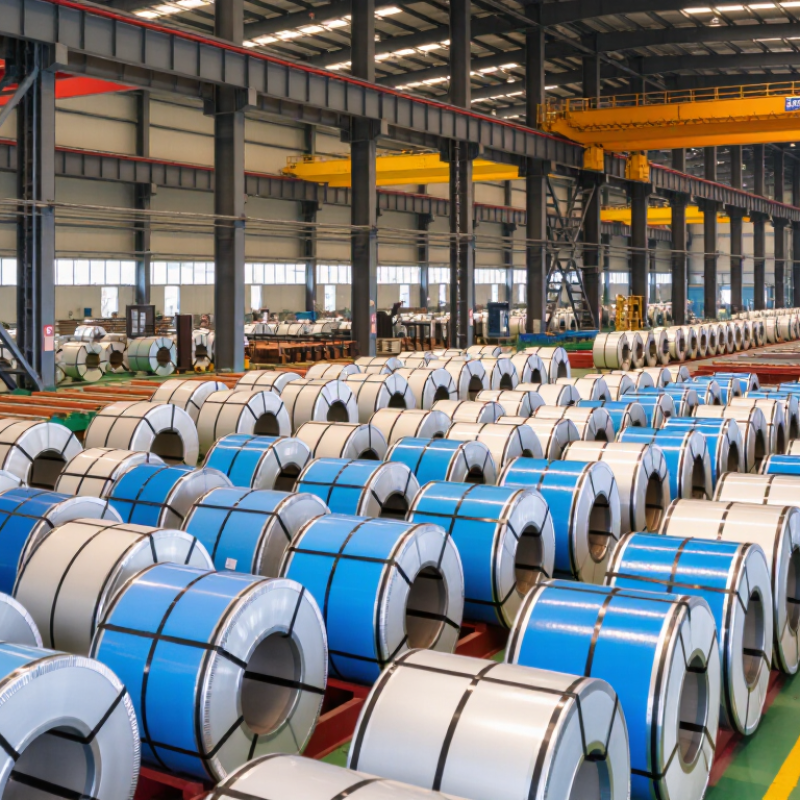
PPGI coated coil is pre-painted galvanized steel supplied in a continuous, rolled strip. Its steel core is coated with zinc, then finished with primer and colored paint. This layered structure improves corrosion resistance and gives manufacturers a ready-to-form surface. It is not simply painted steel. The zinc layer also offers protective support when small surface scratches appear.
Manufacturers use PPGI coil for roofing sheets, wall panels, ceiling systems, doors, and warehouse cladding. It can be cut, bent, stamped, and roll-formed into specific profiles. A construction engineer may select the coil by coating mass, paint type, color, thickness, and width. Coastal projects often need stronger corrosion protection. Indoor applications may require less demanding specifications. Real conditions matter more than attractive color charts.
During supplier evaluation, request mill certificates, coating test results, and samples from the same production batch. Check the surface under direct light for pinholes, uneven gloss, and edge damage. Measure thickness rather than trusting a label. Small errors can affect forming performance. PPGI is durable, but it is not maintenance-free. Cut edges and damaged areas still need proper treatment. In practice, delivery records can be imperfect, and specifications may be misunderstood. That deserves a second check.
Choosing among ten global PPGI suppliers requires evidence, not polished catalogs. World Steel Association’s 2024 World Steel in Figures records 1,888.2 million tonnes of crude steel output in 2023. That scale makes capacity claims easy to exaggerate. Ask for mill origin, coating-line capacity, and recent batch records. Small details matter. A coil tag should match the certificate, invoice, and packing list.
Evaluate substrate quality through grade, yield strength, thickness tolerance, zinc coating mass, paint system, and gloss. ISO 12944 provides corrosion-environment guidance, but it does not replace product testing. Require independent results for adhesion, impact, flexibility, and salt-spray performance. ASTM D3359 and ASTM B117 support comparisons, although test duration cannot guarantee field life. That distinction is often missed. Check whether testing used your exact primer, topcoat, and steel grade.
Reliability also depends on logistics and corrective action. Review delivery records, minimum-order rules, warranty language, and packaging for sea transport. OECD’s 2024 Steel Market Developments highlights persistent global overcapacity concerns, so unusually low prices deserve closer scrutiny. Request two recent customer references and a traceability sample. I would also inspect a warehouse coil for edge damage, wet-storage stains, and uneven wrapping. No supplier is perfect. A transparent response to one defect may reveal more than a flawless presentation.
The ten leading PPGI coated coil suppliers reflect different manufacturing strengths. Profile one focuses on high-volume galvanized substrates, while profile two serves roofing exporters with fast slitting. Profile three offers narrow-gauge coils for appliance panels. Profile four emphasizes heavy coating weights for coastal buildings. Profile five combines color-matching laboratories with small trial orders.
Profiles six and seven specialize in automotive-grade flatness and tight thickness control. Profile eight supplies low-volume architectural colors, often with shorter lead times. Profile nine supports Southeast Asian construction projects with flexible container loading. Profile ten competes through traceable testing, mill certificates, and third-party inspections. The World Steel Association reported global crude steel output of about 1.89 billion tonnes in 2023. That scale explains the broad supplier base, but volume alone does not prove reliable PPGI quality. Coil performance still depends on substrate chemistry, zinc coating, paint system, curing, and storage.
Tips: Request EN 10346 or ASTM-based test records, coating thickness results, and salt-spray evidence. Confirm paint resin type, gloss tolerance, and minimum order width before payment. Check whether the supplier can provide retained samples and batch traceability. A practical mistake is judging only by price. A cheaper coil may hide uneven tension, edge damage, or inconsistent color. I would also question overly perfect claims; real production usually includes some variation. Tensile strength and elongation should match the project specification, not merely the sales sheet.
This chart presents common nominal steel thickness options used in PPGI coated coil specifications. Actual availability, tolerances, coating mass, paint system, and minimum order quantities vary by supplier and project requirements.
Reference dimension: nominal base-steel thickness, measured in millimetres. The listed values are commonly specified commercial thickness levels for PPGI applications in roofing, cladding, panels, and general fabrication.
Choosing among the 10 best PPGI coated coil suppliers requires more than comparing price lists. Product quality appears in measurable details, including coating thickness, paint adhesion, surface consistency, and steel yield strength. During factory evaluations, inspectors should check coil edges, color uniformity, and packaging protection. Small scratches often become larger problems during forming or transport.
Certifications provide useful evidence, but they should not replace direct verification. ISO 9001 can indicate controlled quality procedures, while ISO 14001 reflects environmental management practices. Product certificates should identify the substrate grade, coating mass, paint system, and testing method.
Independent test reports are more convincing when batch numbers match shipping documents. A supplier with clear traceability earns stronger credibility.
Production capacity also affects reliability. Buyers should compare monthly output, available galvanizing lines, curing equipment, and storage space. A large stated capacity may look impressive, yet maintenance schedules and peak-season orders can reduce actual availability. Delivery records matter. So does communication.
A practical comparison should include factory audits, sample testing, and references from similar applications. I would not rank suppliers by capacity alone. That approach can overlook inconsistent coating performance. One limitation remains: public information is often incomplete or outdated. Rechecking certificates and production data before contracting is necessary. Surface appearance is useful, but it is not enough.
How to Select the Right Ppgi Coil Supplier for Your Project
Choosing a PPGI coil supplier requires more than comparing price per tonne. Confirm the steel grade, coating mass, paint system, thickness tolerance, and width accuracy. Request recent mill certificates and independent test results. These documents should match recognized standards, such as EN 10346, ASTM A755, or ISO 12944. A supplier avoiding clear documentation is a warning sign.
Match the coating to the environment. Coastal projects need stronger corrosion protection than interior warehouse panels. Ask for salt-spray results, gloss retention data, and a written warranty with practical exclusions. Check whether the supplier controls slitting, edge quality, packaging, and storage. Small details matter. A damaged coil edge can create costly rejection later.
Industry data also supports examining sustainability and production stability. The International Energy Agency reports that iron and steel production creates about 7% of global energy-related carbon dioxide emissions. Therefore, request emissions information, recycled-content data, and evidence of energy-management practices. The World Steel Association’s 2024 sustainability indicators also show why transparent reporting matters across steel supply chains. Still, supplier claims are not automatically reliable. I have seen attractive technical sheets hide vague tolerances and unclear warranty limits. Compare three offers using the same specification sheet, delivery terms, inspection plan, and corrective-action process. Price should be tested against risk, not viewed alone.
| No. | Supplier Selection Dimension | What to Verify | Recommended Benchmark | Why It Matters for a PPGI Project | Required Evidence |
|---|---|---|---|---|---|
| 1 | Base Steel Grade | Steel designation, yield strength, tensile strength, elongation, and chemical composition. | Grade and mechanical properties should match the project specification, forming method, and applicable standard. | The substrate affects roll forming, bending performance, structural strength, and service life. | Mill test certificate and independent material inspection report when required. |
| 2 | Metallic Coating Mass | Zinc or zinc-aluminium coating type and coating mass on both sides. | Select the coating mass according to exposure conditions; common commercial specifications include approximately 40–275 g/m² total coating mass. | Higher coating mass generally provides improved corrosion protection, but should be balanced against forming and cost requirements. | Coating test results, product specification, and lot-based inspection records. |
| 3 | Paint System | Primer type, topcoat chemistry, back-coat specification, and total paint-film thickness. | Typical total top-surface paint thickness is about 15–35 μm, depending on the coating system and end use. | The paint system influences UV resistance, color retention, adhesion, flexibility, and corrosion performance. | Technical data sheet, coating-production records, and paint-film thickness measurements. |
| 4 | Dimensional Accuracy | Thickness, width, length, coil weight, flatness, edge condition, and shape tolerances. | Tolerances should be stated in the purchase contract and aligned with the applicable steel standard. | Accurate dimensions reduce slitting waste, installation problems, profiling defects, and production downtime. | Inspection plan, calibration records, dimensional inspection report, and approved sample. |
| 5 | Color and Surface Finish | Color reference, gloss level, texture, minor surface defects, and protective-film requirements. | Use an approved color standard or physical sample; define acceptable gloss and visual tolerance before production. | Consistent appearance is essential for roofing, wall cladding, appliances, doors, and other visible applications. | Approved color panel, spectrophotometer results where applicable, and pre-shipment photos. |
| 6 | Formability and Adhesion | Bend performance, coating adhesion, cracking resistance, and suitability for roll forming or stamping. | Confirm the required bend grade, such as a specified minimum inside-bend radius, before ordering. | Poor formability can cause coating cracks, delamination, edge damage, and premature corrosion. | Bend-test results, adhesion-test records, and production trial samples. |
| 7 | Corrosion and Weather Resistance | Exposure category, humidity, salt contamination, UV intensity, temperature variation, and warranty conditions. | Specify the intended environment and test method; do not select a coating solely by color or nominal paint thickness. | A suitable coating system is critical for coastal, industrial, high-humidity, and high-UV applications. | Corrosion-test data, weathering-test data, product warranty, and application limitations. |
| 8 | Production Capacity and Lead Time | Monthly capacity, minimum order quantity, available widths, production schedule, and delivery reliability. | The supplier should confirm capacity for the complete project volume and provide a written production and shipping schedule. | Reliable supply protects construction schedules and reduces the risk of color or specification changes between batches. | Capacity statement, recent delivery records, production plan, and agreed order milestones. |
| 9 | Packaging and International Logistics | Coil eye orientation, waterproof wrapping, edge protection, pallet or skid design, marking, and loading method. | Packaging should protect against moisture, abrasion, deformation, and handling damage during multimodal transport. | Correct packaging reduces white rust, paint scratches, coil collapse, and claims after long-distance shipment. | Packaging specification, loading photos, weight list, shipping documents, and cargo-insurance terms. |
| 10 | Quality Assurance and Technical Support | Traceability, complaint handling, technical communication, inspection access, and corrective-action process. | Prefer suppliers with documented quality procedures, batch traceability, clear acceptance criteria, and defined response times. | Strong after-sales support helps resolve coating, dimensional, delivery, and application issues quickly. | Quality manual, traceability sample, inspection certificate, corrective-action template, and warranty terms. |
Note: PPGI specifications should be finalized according to the project environment, applicable national or international standards, forming process, and contractual inspection requirements.